Service
Wolf range and rangetop repair — burners, griddle, oven heat
Burners that will not light, a griddle that runs cold at one end, an oven that reads one temperature and holds another. Sealed burners, igniters, spark modules, valves and the electric oven side of a dual fuel range.
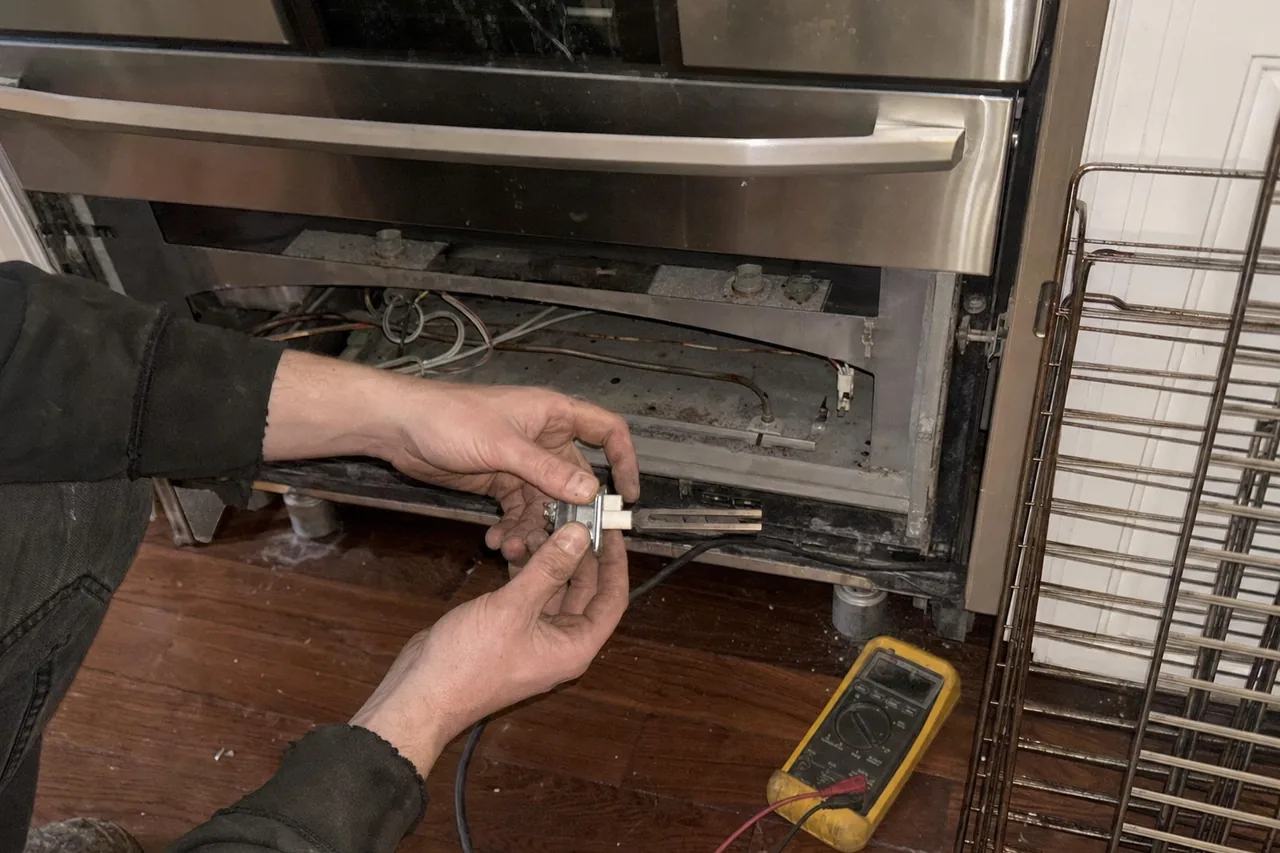
What people describe when they call
- A surface burner clicks and clicks but never lights
- One burner lights, the rest do not
- The flame is yellow and lifts off the cap
- The oven overshoots the set temperature, then undershoots
- The oven will not go past a low temperature at all
- The griddle is hot at one end and cool at the other
- The charbroiler will not glow evenly across its width
- The oven light stays on with the door shut
- The door will not seal and heat escapes at the top corners
- An induction element cuts out under a heavy pan
A range is the appliance a kitchen is built around, so when it stops behaving the household notices within an hour. Almost everything that brings us out falls into three groups, and the three are diagnosed in completely different ways. Say which group you are in when you call and the visit gets shorter.
Ignition faults
A burner that clicks without lighting is almost never a dead spark module. Far more often the electrode is wet, the burner cap is sitting a millimetre out of its seat, or a port is blocked with something that boiled over a week ago and carbonised. Those are ten-minute problems, and a cap that has been lifted for cleaning and dropped back at a slight angle accounts for a surprising share of them.
The module itself only enters the picture in two situations: nothing on the whole cooktop sparks, or one position sparks continuously with every knob off. The second is the more useful symptom, because a switch that will not open is a different part from a module that will not fire.
Gas quality matters here too. A yellow flame that lifts away from the cap is telling you about the air-to-gas ratio, not about the burner. On a range that has been converted between natural gas and LP — common on Anastasia Island, where houses on tanks sit a few streets from houses on a main — the first thing worth confirming is that the conversion was finished properly: orifices, the regulator setting, and the low-flame adjustment on every valve, not just the two front burners somebody tested at the time.
Temperature faults
An oven that swings either side of its setpoint is usually reporting the truth about a failing sensor rather than a failing control board. The sensor is a resistance device. It has a known value at a known temperature, and it either matches or it does not. Measuring it takes a minute. Replacing a board because an oven runs hot is an expensive way to not fix anything, and we measure before we quote.
The other half of the temperature story is not electrical at all. An oven that cannot reach its setpoint is often losing heat as fast as it makes it, and heat leaves through the door. A range that has been cooking for fifteen years has had its door pulled open several thousand times; hinge springs relax, and the door stops pulling itself flat against the gasket. You can usually feel the escape at the top corners with the back of your hand.
Griddles, charbroilers and the flat surfaces
A griddle that is hot at one end and cool at the other is describing its heat source, and on a gas range that means a burner underneath is not producing what it should across its full length. On the electric side of a dual fuel range it means an element or its control has partly failed. Either way, an infrared reading across the plate at a settled temperature turns an argument into a number, and that number goes on the estimate.
What we do not do
We service Wolf and nothing else. That is a deliberate limit, and it is the reason the diagnostic visit is spent measuring instead of learning. The parts that fail in these ranges are not a surprise to us, the sensor values are already known, and the van carries what the failure list says it should.
The visit is a flat $80, credited in full toward the repair if you go ahead. You get a written estimate before any part is ordered. Labour is warranted for 90 days and parts for 365, and the parts are genuine OEM — a sealed burner assembly from a parts catalogue is not the same casting, and it will not seat the same way.
What gets checked
- Gas supply pressure at the manifold, and the regulator setting for the fuel actually delivered
- Spark module output and the continuity of every electrode lead
- Burner cap and port alignment, which is the usual cause of a lifting yellow flame
- Oven sensor resistance against the expected value at room temperature
- Door seal compression and hinge tension across the full width
- Convection fan bearing noise and blade clearance
- Cooling fan airflow and vent clearance behind the kick panel
Flat $80 diagnostic, credited to the repair. You get a written estimate before any part is ordered or any labour is billed. 90 days on labour, 365 days on parts, genuine OEM parts only.
The fee, then the band the part sits in
Money
What does range and rangetop repair cost?
The bands below are the ones this work falls into. Everything else on the book is on the pricing page.
| Work | Parts and labour |
|---|---|
| Diagnostic visit | $80 flat, credited |
| Igniter or spark module replacement | $190–$500 |
| Burner valve or orifice service | $210–$650 |
| Oven thermostat or temperature sensor | $170–$520 |
| Convection fan or motor | $250–$730 |
Bands, not quotes: they are what this work has actually cost, parts and labour together, from $80 at the door to the firm figure that goes on paper after the diagnosis. The whole table
- What does range and rangetop repair cost?
- The visit is a flat $80, credited in full against the repair. After that the price follows the component that failed: Igniter or spark module replacement runs $190–$500, burner valve or orifice service $210–$650, parts and labour together. You get a written estimate before any part is ordered or any labour is billed.
- Is the $80 charged on top of the repair bill?
- No. Flat $80 diagnostic covering the visit and the full diagnostic sequence, credited toward the repair once you approve the work. If you decide against the work, the fee stands and the written diagnosis is yours to take anywhere — it names the failed part and the part number.
- When is replacing the appliance the better buy?
- Replacing instead of repairing runs $5,200–$10,500 (wall oven or built-in oven, the usual repair-or-replace comparison) or $8,500–$16,500 (dual-fuel or gas range, 36 inch and up). A comparable Wolf range, rangetop or wall oven, appliance only — before delivery, installation, ventilation or cabinetry. National appliance pricing, not Florida labour. Against those figures a repair at $190–$500 is the cheaper course in most kitchens.
Places this comes up
Written up in full
- A Wolf oven that won't turn on: the breaker, lockouts, outages and a dead display How to wake a silent Wolf oven: cycle the breaker for 30 seconds, rule out demo mode, the 12-hour shut-off and outage lockouts, then know when a dark display means a failed control part.
- Wolf appliance maintenance: a calendar for the hood, burners, ovens and coffee system A maintenance routine for Wolf cooking appliances, sorted by interval: what an owner can safely clean or replace, what to leave alone, such as the oven door gasket, and what a technician's yearly check adds.
- The oven is not heating, and what that narrows to Not heating at all and not heating enough are two different faults. What gets measured first on a Wolf oven: the burner igniter's current draw, the safety valve it is meant to open, the temperature sensor's resistance, the door seal. The control board comes last, not first.
- Fitting a 48-inch Wolf range to a 1920s St. Augustine kitchen Width is the least of it. Floor level, load, clearances, the electrical supply and a duct route that does not exist yet all decide whether a pro range works in an old house or merely fits in it.
- What to check before you call us Some of these end the problem without a visit. The rest turn a vague complaint into a specific one, which is the difference between a diagnosis and a guess. Plus the three things not to touch.
- The burner that clicks in an old St. Augustine kitchen The most common call we take, and the one most often fixed without a part. Where the fault actually sits, what you can safely check yourself, and the single symptom that means stop and phone.
- The appliance fault that arrives weeks after the storm Northeast Florida takes thunderstorms most of the summer and has had multi-day outages more than once. Appliance electronics often survive the event and fail some weeks later, which is why the outage never gets mentioned on the call.
What people said after this work
Customer feedback
After Range and rangetop calls
4.3 out of 5, across 87 customer reviews. Each entry below is one visit, in the words of the person who paid for it.
The broiler would only light across one half. He cleaned the burner face and fitted a new igniter, and it works. I would have liked the old part put in my hand rather than taken away unseen.
Quentin O.
Getting a range out of a house this old is half the job. He measured the opening before he lifted anything, protected the heart pine floor, and had it back in square with the door lining up again.
Alaric D.
Our range began tripping the breaker whenever the broiler ran. He found a lead pinched behind the back panel where it passes the vent, sleeved it and rerouted it. Solid work; I chased the booking twice to get it.
Barnaby G.