maintenance
Wolf appliance maintenance: a calendar for the hood, burners, ovens and coffee system
A maintenance routine for Wolf cooking appliances, sorted by interval: what an owner can safely clean or replace, what to leave alone, such as the oven door gasket, and what a technician's yearly check adds.
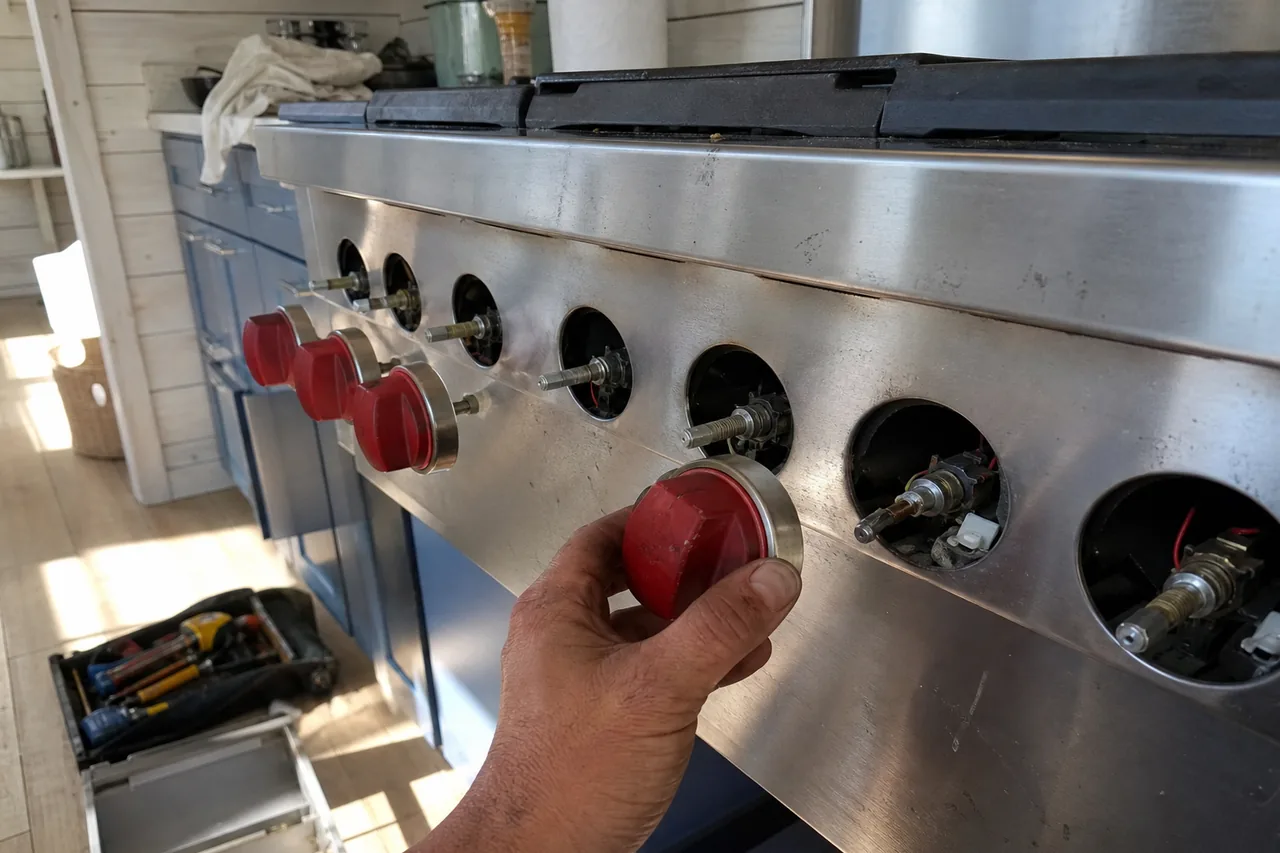
Wolf appliance maintenance is mostly a calendar of small jobs an owner can do at the sink: wash the hood filters every three to six months, soak the coffee system’s infuser and wash its tank once a month, change its charcoal filter every second month, and descale the steam oven when the display asks. Add a gentle scrub of grates and igniters when they look grimy, plus a technician’s yearly look at the parts nobody sees.
Knowing what to leave alone matters just as much, because a few natural cleaning habits are exactly the ones Wolf’s care guides warn against.
The routine at a glance
- Monthly: soak the coffee infuser, wash the coffee water tank, wipe knobs with a damp cloth.
- Every two months: fit a fresh charcoal filter in the coffee system.
- Every three to six months: wash the hood filters, spacers and grease cups.
- Every 6 to 18 months: descale the steam oven, sooner where the water is hard.
- Once a year: a technician’s check of gas flow, ignition, seals and fans.
Burners, grates and knobs
Cast-iron grates from a Wolf gas cooktop come clean best at the sink with hot water and a mild detergent, or a baking soda paste for anything burnt on. Scrub them by hand rather than sinking them in a tub; Wolf asks that they not be immersed. The knobs pull straight off, but a damp cloth is all they should get.
Igniters are the small ceramic tips beside each burner. If grease has crusted on one, a soft toothbrush used gently will usually clear it. An igniter that is cracked, chipped or loose in its mount is no longer a cleaning job and needs a repair visit. When the caps go back on, make sure each sits flat, because a rocking cap gives a ragged flame and a slow light.
A range griddle’s seasoning needs stripping now and then. Wolf’s method is half a cup (120 ml) of warm water with a teaspoon (5 ml) of griddle cleaner, the loosened residue scraped into the grease tray, and fresh oil once the plate is dry. For the charbroiler, leave it burning for 10 minutes after the meal, then let the grate cool under wet towels and hot water before you scrub.
The oven: what not to clean
The oven suffers most from good intentions. Wolf tells owners not to clean the soft door gasket at all, since rubbing or nudging it can spoil the seal that holds heat in. Clean around it, never on it.
Foil is the other trap. Lining the floor or side walls with aluminum foil harms the porcelain finish and, by Wolf’s own terms, voids the warranty; a pan set straight on the oven floor does similar harm. If the door stops closing firmly or the gasket looks torn, hinge, glass and seal work typically lands in the $180–$640 range, with the firm figure settled after diagnosis.
Steam oven: tap water and descaling
A Wolf convection steam oven depends on the minerals in fresh cold tap water, so demineralized, filtered or distilled water is the wrong choice. A full tank gives roughly four hours of steam on a 24-inch model and two on a 30-inch one. For everyday cleaning, run the Clean mode at 176°F (80°C) for 30 minutes, then wipe the interior. Hand-wash the water tank.
Those minerals also mean descaling, anywhere from every 6 to 18 months depending on water hardness, announced by “Boiler Scaled Up, Please Descale!” on the display. The cycle takes about 45 minutes and draws 16.9 oz (500 mL) of solution. Wolf names one descaler, part number 820021, and asks for the whole bottle each time, because other products can cause permanent damage.
Coffee system: small jobs, often
The built-in EC2450 and EC3050 coffee systems need the most frequent care. Once a month, lift out the infuser, the assembly that tamps and brews each shot, and let it sit in plain water for about five minutes. Skip the detergent, which strips the lubricant the infuser relies on, and wash the water tank the same day.
Every two months, swap in a new charcoal filter, part number 830406. For descaling, Wolf specifies part number 829244, a box of two 3.40 fl oz single-use packets, and the cycle needs a container of at least 85 oz (2.5 L) under the spout, so a mug will not do.
The hood: filters and salt air
Filters, spacers and grease cups on a Wolf pro hood should come out for washing every three to six months. Never run the blower while they are out, even while they dry, because grease then travels straight into the fan and duct. When a filter is bent past saving, order by number: a pro wall hood such as the PW302418 takes baffle filter 811180, measuring 11-7/8 by 11-7/8 inches, while the VW30S, VW36S and VI42S cooktop hoods take mesh filter 825596.
Near the water, as in Davis Shores, salty air settles on the blower with the grease, so stay at the short end of that interval. Our note on salt air and the hood blower goes further.
What a technician’s visit adds
Owner maintenance cleans; it does not measure. A technician takes the knobs off to inspect the valve stems and spark switches behind the panel, watches each burner for a prompt light and a steady blue flame, and tests igniters that look healthy but have weakened. On the oven, the checks are temperature accuracy against a separate probe, the hinges and gasket, and a quiet convection fan; on the hood, the blower motor and bearings.
That visit starts with the $80 diagnostic. A tired igniter or spark module typically runs $190–$500 to replace, with the firm figure given once the fault is confirmed. Coquina Hearth Service runs independently of the brand and its own repair network. Before booking, run through what to check before you call, since a tripped breaker or a closed gas shutoff is worth ruling out first.