Repair or replace
When the repair is worth it, and when it is not
It is a question with two numbers in it, and most of the anxiety comes from only ever being shown one of them. Both tables are below, and the flat $80 diagnostic is what turns a band into the firm figure you weigh against them.
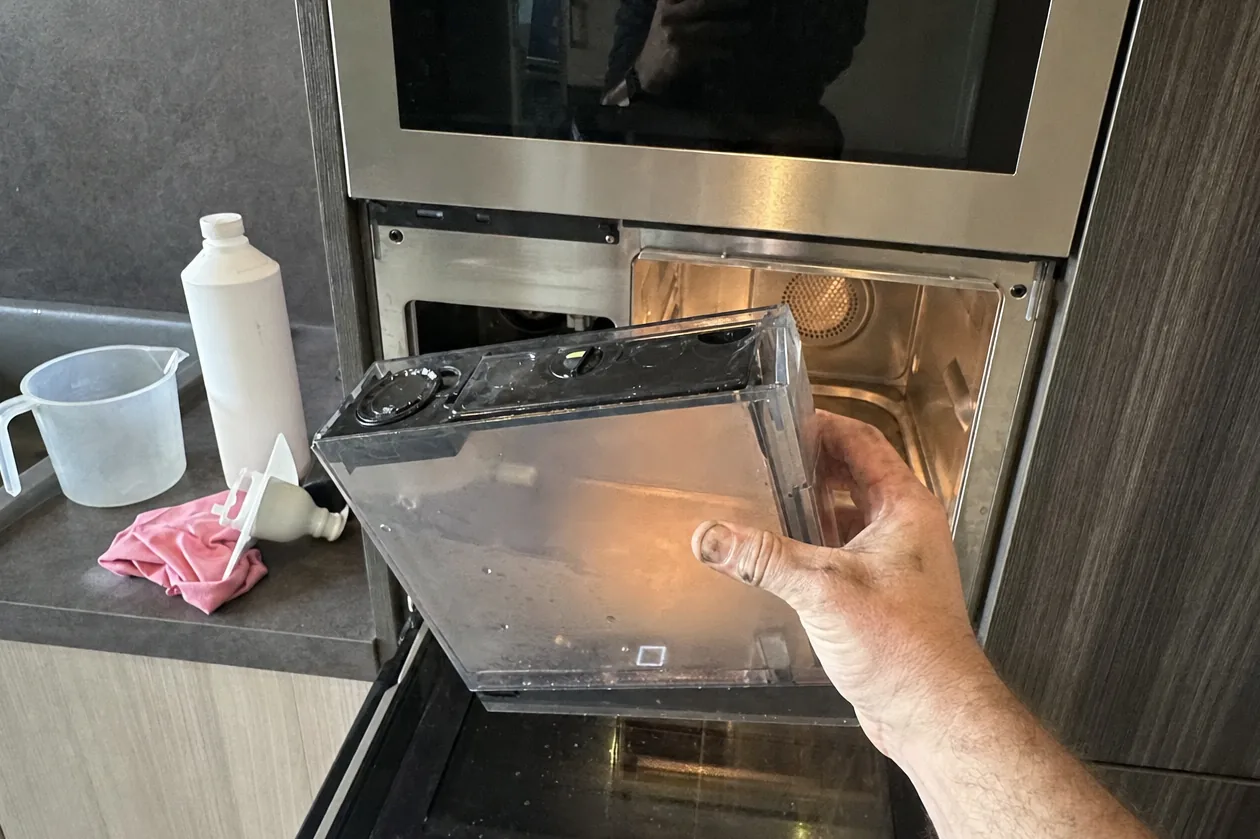
A built-in cooking appliance is not a thing you can carry out to the kerb. It was fitted into an opening cut to its dimensions, wired to a circuit sized for it, and in most St. Johns County kitchens the cabinetry was finished around it afterwards. That is why the two sides of this comparison are so lopsided, and why the arithmetic is worth doing properly rather than by feel.
The repair side is a band: what that work has actually cost, parts and labour together. The replacement side is the appliance on its own — not the delivery, not the fitting, not the ventilation and not the joinery that follows a change of width by even an inch.
What the repair costs
The four bands the judgement usually turns on. The whole book is on the pricing page.
Money
What does the repair side of the comparison cost?
These are the dearer end of the book, because a cheap repair was never the thing anyone was weighing against a replacement. The visit itself is a flat $80, credited.
| Work | Parts and labour |
|---|---|
| Diagnostic visit | $80 flat, credited |
| Control board or touch panel | $420–$1,100 |
| Burner valve or orifice service | $210–$650 |
| Convection fan or motor | $250–$730 |
| Door hinge, glass or seal | $180–$640 |
Bands, not quotes: they are what this work has actually cost, parts and labour together, from $80 at the door to the firm figure that goes on paper after the diagnosis. The whole table
- How do I work out whether this repair is worth it?
- Hold the band against the replacement figure. Control board or touch panel — the dearest work in this book at $420–$1,100 — sits against $5,200–$10,500 for a comparable oven, appliance only. The diagnostic turns the band into a firm number first, so the comparison is made against a figure rather than a fear.
- What decides whether a quote lands at the top of its band or the bottom?
- Which part failed, whether it is on a shelf or on order, and how much has to come out of the cabinetry to reach it. The same board behind a tight built-in opening is more labour than one in an accessible run, and the estimate says which of those you have before any part is ordered.
- What happens if the honest answer is that it is not worth repairing?
- You get that in writing, with the part price that led to it, so the conclusion can be checked by somebody else. The $80 stands and the document is yours — including to take to whoever sells you the replacement, who will ask what failed.
What replacing it costs instead
| Replacing instead | Appliance only |
|---|---|
| Wall oven or built-in oven, the usual repair-or-replace comparison | $5,200–$10,500 |
| Dual-fuel or gas range, 36 inch and up | $8,500–$16,500 |
A comparable Wolf range, rangetop or wall oven, appliance only — before delivery, installation, ventilation or cabinetry. National appliance pricing, not Florida labour.
Three cases, and which one you are in
When the repair is clearly the buy
One named part has failed, it is still catalogued, and the band it sits in is a fraction of $5,200–$10,500. That is the ordinary case and it is not close: even control board or touch panel at the top of its band, $420–$1,100, is a small share of the cheapest replacement in the table above — and the replacement figure is before anybody has touched the opening.
When it is a genuine judgement call
Two faults of the appliance's own make it one. The first is a second failure arriving alongside the first: a control failure and a heat failure on the same visit stack two bands, and two bands are a different conversation from one. The second is a part that has gone to long lead time — the repair still wins on price and loses on a kitchen with no oven in it for weeks, which is a cost the table cannot price for you.
There is a third that belongs to the kitchen rather than the appliance, and it is worth saying plainly: if you were already going to change the kitchen, the arithmetic stops being about the appliance. A unit coming out anyway is not worth a board.
When replacing is the honest answer
When the part is no longer made. That is the line, and it is not a matter of age: a long-serving appliance whose components are still catalogued is a repairable appliance, and a newer one whose assembly has been discontinued may not be. When we find that, the written diagnosis says so, names the part and the part number, and you keep it whether or not we do any work.
The other case is damage rather than wear — a cavity or a manifold that has been compromised rather than a component that has worn out. That is a judgement made with the panel off, which is what the diagnostic is for.
The diagnostic, and what it leaves you holding
Flat $80 diagnostic, credited in full toward the repair if you go ahead with it. You get a written estimate before any part is ordered or any labour is billed. Whichever way the comparison goes, what you are left holding is the same document: the failed component, its part number, its price and the labour to fit it. That is what makes the decision yours rather than ours.
If the repair goes ahead, what follows it is fixed: 90 days on labour, 365 days on parts, genuine OEM parts only. A return visit for the same fault inside the labour window is not billed again.
The whole price book is on the pricing page, the appliances this bench works on are listed under services, and the shorter answers are on the questions page. Book a diagnostic or call +1 (904) 478-8963.
What people said once the number was on paper
Customer feedback
After the comparison was made
4.3 out of 5, across 87 customer reviews. Each entry below is one visit, in the words of the person who paid for it.
Taking a hood duct through a masonry wall in this part of town is not simple. He worked out a route with fewer turns, fitted a proper wall cap, and the kitchen clears instead of holding smoke.
Ottavio B.
Water pooled under the tank housing after every run. He found the overflow pipe pushed off its stub behind the panel, refitted it with a clip, and dried out everything underneath before he left us.
Emeline T.
The wall oven ran hot and burned everything on the base. He recalibrated it and fitted a new sensor, which sorted it out. The work was good; getting anyone to pick up the phone beforehand was not.
Leopoldine R.