Service
Wolf built-in coffee system repair — short shots, lukewarm cups, leaks
The most heavily cycled appliance in the kitchen, and the one with the tightest tolerances. Grinders, brew units, pumps, heaters and milk circuits, diagnosed in the cabinet the unit was built into.
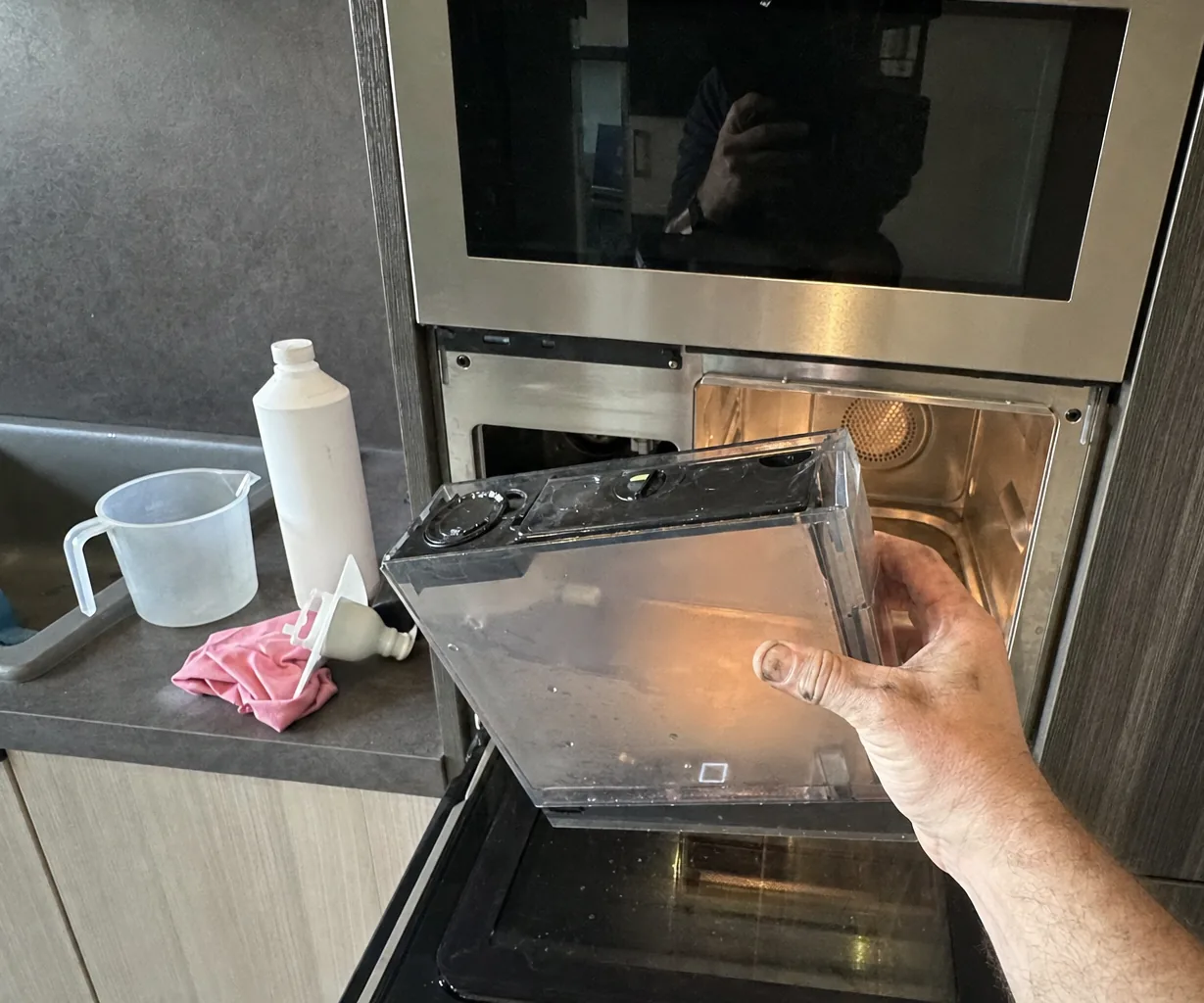
What people describe when they call
- Shots have gone short, slow and bitter
- The machine asks to be descaled and the cycle will not clear it
- Coffee comes out lukewarm however the temperature is set
- The grinder runs but very little ground coffee reaches the brew unit
- Water leaks into the cabinet beneath the unit
- The milk system stops frothing and only heats
- The pump is much louder than it used to be
- The unit reports a water fault with a full reservoir
A built-in coffee system is the most heavily cycled appliance in a modern kitchen and the one built to the tightest tolerances. It grinds, doses, heats and pressurises several times every morning, three hundred and sixty-five mornings a year, in a machine sitting inside joinery where nobody can see what it is doing. Nothing else in the room works that hard, and it usually shows its age first.
Short, slow shots are a flow problem
The complaint almost always arrives as taste. Shots have gone bitter, they take too long, the crema is thin. That is a description of restricted flow, and there are only three plausible places for the restriction: the grind, the brew unit, or the water path.
The grind is worth eliminating first because it costs nothing. Burrs wear, worn burrs produce more fines, and fines choke a puck. If the grind setting has crept finer over months to keep the drink tasting right, the burrs have been telling you something and the machine has been compensating on your behalf.
The brew unit is next. It is a mechanism — seals, and a piston that travels under pressure — and coffee oils turn to varnish on exactly the surfaces that have to move. A brew unit that is stiff to work by hand out of the machine is stiff inside it too, and stiffness shows up as inconsistent volume long before it shows up as a fault code.
The water path is last, and it is the one that needs a schedule rather than a repair. The descale prompt is a counter, not a measurement: it knows how many cycles have run, not what has gone through. Act on it the first time it appears rather than the third, and if a descale cycle will no longer clear the prompt, stop repeating it — a cycle that cannot complete is reporting a restriction, and more chemical does not reach the far side of a blockage.
Lukewarm coffee and a loud pump
These two complaints sound unrelated and often are not. A heater that has to work harder to reach a temperature it increasingly fails to deliver, and a pump straining audibly against a path that will not pass what it is being asked for, are two readings of the same underlying condition. We measure both rather than infer either: continuity and cut-out on the heater, the temperature actually arriving at the spout, and pump pressure under load rather than at rest, because a pump that is fine at rest can fall away the moment it is asked to work.
Leaks under the unit
Water in the cabinet is worth acting on quickly, not because the leak is expensive but because the cabinet is. A built-in unit sits in joinery, and a slow drip from a hose clip or a reservoir seal will be absorbed by a cabinet base for weeks before anyone sees it. If you have found water, stop using the machine and call. The repair is usually small; the delay is what costs.
Milk systems
A milk circuit that heats but no longer froths is an air-intake problem far more often than a pump problem — a blocked air hole, a perished line, or milk residue that has set inside a connector. These respond to cleaning discipline more than to parts, and part of the visit is showing you which cleaning routine the machine actually needs rather than the one that is convenient.
Access, power and what we ask before we arrive
A built-in coffee system is serviced in place where it can be and on the bench in front of it where it cannot. Clear the cabinet below and beside the unit before we arrive; a good deal of the plumbing and every hose clip live in that space.
Two questions we ask on the phone. Whether the unit is plumbed into a supply line or filled from a reservoir, because a plumbed installation brings an inlet valve, a filter and a shut-off into scope. And whether it has a circuit of its own — a machine sharing a circuit with something that cycles behaves erratically under load and looks electronic when the fault is electrical.
Parts and the serial number
Model and serial, both, from the rating plate. Assemblies change mid-production, so brew units, pumps, boards and grinder components can differ between machines wearing the same model badge. Ordering from the model alone is how a two-visit repair becomes three. Stocked parts move quickly; serial-specific ones go on order, and lead time goes on the written estimate rather than arriving as news a week later.
Flat $80 to diagnose, credited toward the repair. Written estimate before any part is ordered, 90 days on labour, 365 on parts, genuine OEM parts only.
What gets checked
- Brew unit travel and seal condition, removed and worked by hand
- Pump pressure under load rather than at rest
- Heater and thermal cut-out continuity, and the temperature actually delivered at the spout
- Grinder burr wear and the path between burr and brew chamber
- Reservoir seal, pickup and every hose clip in the cabinet
- Descale cycle run end to end, watching where it stalls rather than only whether it clears
- Milk circuit, its lines and the cleaning routine actually being used
Flat $80 diagnostic, credited to the repair. You get a written estimate before any part is ordered or any labour is billed. 90 days on labour, 365 days on parts, genuine OEM parts only.
The fee, then the band the part sits in
Money
What does built-in coffee system repair cost?
The bands below are the ones this work falls into. Everything else on the book is on the pricing page.
| Work | Parts and labour |
|---|---|
| Diagnostic visit | $80 flat, credited |
| Oven thermostat or temperature sensor | $170–$520 |
| Door hinge, glass or seal | $180–$640 |
Bands, not quotes: they are what this work has actually cost, parts and labour together, from $80 at the door to the firm figure that goes on paper after the diagnosis. The whole table
- What does built-in coffee system repair cost?
- The visit is a flat $80, credited in full against the repair. After that the price follows the component that failed: Oven thermostat or temperature sensor runs $170–$520, door hinge, glass or seal $180–$640, parts and labour together. You get a written estimate before any part is ordered or any labour is billed.
- Is the $80 charged on top of the repair bill?
- No. Flat $80 diagnostic covering the visit and the full diagnostic sequence, credited toward the repair once you approve the work. If you decide against the work, the fee stands and the written diagnosis is yours to take anywhere — it names the failed part and the part number.
- When is replacing the appliance the better buy?
- Replacing instead of repairing runs $5,200–$10,500 (wall oven or built-in oven, the usual repair-or-replace comparison) or $8,500–$16,500 (dual-fuel or gas range, 36 inch and up). A comparable Wolf range, rangetop or wall oven, appliance only — before delivery, installation, ventilation or cabinetry. National appliance pricing, not Florida labour. Against those figures a repair at $170–$520 is the cheaper course in most kitchens.
Places this comes up
Written up in full
- Wolf appliance maintenance: a calendar for the hood, burners, ovens and coffee system A maintenance routine for Wolf cooking appliances, sorted by interval: what an owner can safely clean or replace, what to leave alone, such as the oven door gasket, and what a technician's yearly check adds.
What people said after this work
Customer feedback
After Built-in coffee system calls
4.3 out of 5, across 87 customer reviews. Each entry below is one visit, in the words of the person who paid for it.
The brew unit had started sticking part way through and stopping with the grounds still in it. He lifted it out, found the drive cam worn on one flank, fitted a replacement and ran two cycles back to back.
Ondina W.
The coffee unit flagged a grinder jam and would not clear it. He got a small stone out of the burr chamber, which had come in with the beans, checked the burr alignment and reset the grind for us.
Lachlan P.
Ours had begun throwing its own start-up error in humid weather. He dried the board area, traced a drip path from the tank seat above it, and rerouted the overflow so nothing can land there again.
Sylvie X.