St. Johns County
Palencia, 32095 — steam ovens, coffee systems and a hood the house starves
Palencia's kitchens were drawn around the appliances, so the installation faults we meet downtown are largely absent. What replaces them is the building envelope: a hood cannot move air the house will not let in.
The conditions here
- ZIP codes
- 32095
- Kitchens
- Built from the 2000s onward
- Salt air
- Inland; corrosion is not the main driver here
- Installation
- Planned — full openings, dedicated circuits, duct routes designed in
Neighbourhoods: Palencia
Palencia sits west of the Intracoastal on the 32095 side of St. Augustine, along US 1 north of the city. It is far enough back from open water that salt is not the driver here, and recent enough that almost nothing in these kitchens is a retrofit. What we get called out for reflects both of those facts.
Kitchens designed around the appliances
The housing stock here is new enough that the openings were drawn to the specification rather than cut later to accept it. A 48-inch range sits in a 48-inch opening with its clearances intact, the floor beneath it is flat and does not deflect, an induction cooktop has a circuit of its own, and the hood over the rangetop had a duct route planned before the joinery went in.
That removes an entire class of fault we meet in the old streets downtown, and it is worth saying plainly, because it changes where a diagnosis starts. When an oven in a purpose-built kitchen will not hold a setpoint, the building has already ruled out the two usual suspects — an out-of-level range and a door sealing at three corners of four — so we go straight to the sensing and the heat: probe resistance measured cold, then the temperature actually delivered into the cavity logged across a full cycle rather than read off the display.
The envelope is the problem that replaces them
What a modern house substitutes for installation faults is air. An envelope built to current standards is sealed tight, and a hood cannot exhaust air the house will not let back in. In Palencia the ventilation complaints we get are far more often make-up air than blower failure: the fan is loud, the kitchen does not clear, and exterior doors are noticeably harder to pull open with the hood on high.
The counter-intuitive tell is that the hood works better on medium than on high. Nobody volunteers that, so we ask. A blower fighting a pressure it was never sized for moves less the harder it is driven, and no motor replacement fixes it. The house needs a path; the appliance does not need a part.
Where our work stops, and whose it becomes
That path is not ours to build, and it is worth being exact about why. This is a kitchen bench: Wolf ranges and rangetops, wall ovens, cooktops, convection steam ovens, built-in coffee systems, and the hood and blower over them. Heating and air conditioning are a different trade with a different licence. We do not install or repair furnaces, heat pumps, air handlers or air-conditioning systems, we do not run or replace the conditioned-air ductwork behind a Palencia ceiling, and we do not fit make-up air units.
What you get from us on an envelope fault is the number — the pressure difference measured across the house with the hood on high, and the airflow reaching the capture area — written into the diagnosis. Hand that to a mechanical contractor and the conversation starts at the answer rather than at the guess.
Steam ovens and coffee systems
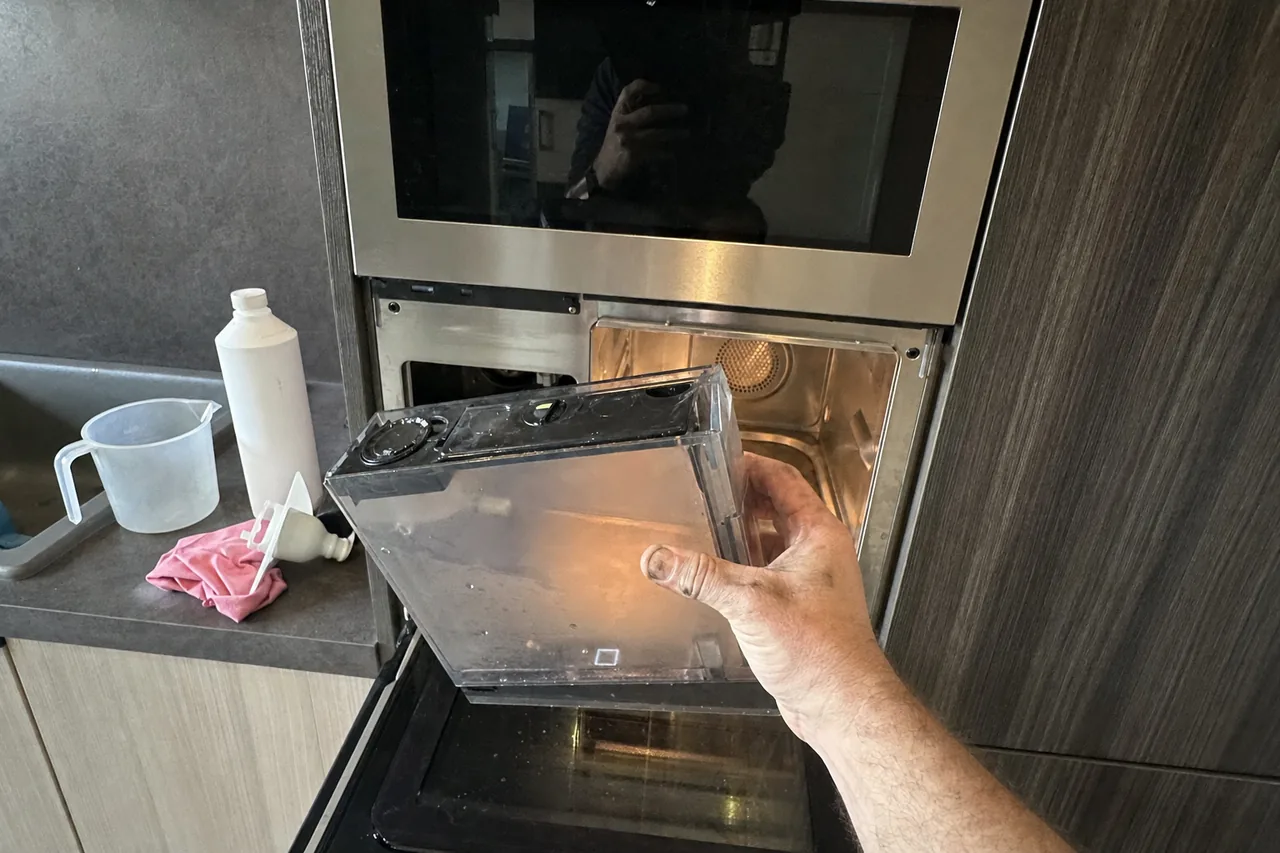
Two appliances in the kitchen boil water and keep what was dissolved in it, and they are the two that ask to be descaled. JEA reports tap-water hardness for 32095 at 355 ppm as calcium carbonate, which is reason enough to treat the manufacturer’s descale prompt as an upper bound rather than a suggestion and to act on it the first time it appears. Nothing else on our bench is touched by it.
Both fail in the same order, which is worth knowing, because the first stage is a clean and the last is a part. The narrow passages restrict first, so the appliance reports that it cannot get water while the reservoir is plainly full. The level sensing misreports second, and cycles start aborting at unpredictable points. The generator or boiler goes last. A cycle that will not complete is reporting a restriction rather than asking to be run a fourth time.
What we check, and in what order
On a sealed burner that clicks and will not light, spark comes first: whether there is one at all, and whether it is arriving at the electrode rather than tracking to the nearest earthed edge. Then cap seating and the port pattern. Then the gas side — manifold pressure measured under load, not at rest, because a regulator that holds its number with one burner lit can sag with four.
On an oven that browns unevenly, the door comes before the electronics: gasket compression along all four sides, hinge tension, then convection fan direction and speed, then the probe.
On a coffee system with short, slow shots, the grind goes first because it costs nothing to eliminate, then the brew unit worked by hand off the machine, then pump pressure under load, and only then the water path.
The order is not a ritual. It runs cheapest-and-most-likely first, and it is what stops anyone selling a part to answer a symptom that five minutes of measurement would have explained.
Parts, and why we ask for the serial number
Have the serial number ready when you call, not only the model. Assemblies change mid-production, and two ranges wearing the same model badge can take different igniters, different valves and different boards depending on where in the run they were built. Ordering from the model alone is how a two-visit repair becomes a three-visit one. Stocked parts we can usually move on quickly; serial-specific ones go on order, and the written estimate says which is which before you agree to it rather than afterwards.
Palencia is a straightforward run up US 1 and close enough to the city that a morning call is usually a same-day visit. Flat $80 to diagnose, credited toward the repair.
What we are called out for here
Flat $80 diagnostic, credited to the repair. Call +1 (904) 478-8963 .
What a visit to Palencia costs
Money
What does a repair in Palencia cost?
The flat diagnostic is the same everywhere we go. What follows it is the band the failed part sits in.
| Work | Parts and labour |
|---|---|
| Diagnostic visit | $80 flat, credited |
| Igniter or spark module replacement | $190–$500 |
| Convection fan or motor | $250–$730 |
| Oven thermostat or temperature sensor | $170–$520 |
| Burner valve or orifice service | $210–$650 |
Bands, not quotes: they are what this work has actually cost, parts and labour together, from $80 at the door to the firm figure that goes on paper after the diagnosis. The whole table
- What does a repair cost in Palencia?
- The same as anywhere else we go: a flat $80 diagnostic, credited to the repair, then the band the failed part sits in. Igniter or spark module replacement runs $190–$500, convection fan or motor $250–$730, parts and labour together.
- Is there a travel charge to Palencia on top of the $80?
- Not inside the 40 miles around St. Augustine that this bench covers, and Palencia is inside it. Beyond that radius the travel is quoted before you commit. Hours are Mon–Fri 8am–6pm · Sat 9am–4pm · Closed Sunday.
- What happens if the appliance is not worth repairing?
- We say so in writing, with the part price that led to the conclusion. Replacing instead of repairing runs $5,200–$10,500 (wall oven or built-in oven, the usual repair-or-replace comparison) or $8,500–$16,500 (dual-fuel or gas range, 36 inch and up). A comparable Wolf range, rangetop or wall oven, appliance only — before delivery, installation, ventilation or cabinetry. National appliance pricing, not Florida labour.
Field notes from this ground
- The oven is not heating, and what that narrows to Not heating at all and not heating enough are two different faults. What gets measured first on a Wolf oven: the burner igniter's current draw, the safety valve it is meant to open, the temperature sensor's resistance, the door seal. The control board comes last, not first.
- The appliance fault that arrives weeks after the storm Northeast Florida takes thunderstorms most of the summer and has had multi-day outages more than once. Appliance electronics often survive the event and fail some weeks later, which is why the outage never gets mentioned on the call.
What people here said afterwards
Customer feedback
After calls in Palencia
4.3 out of 5, across 87 customer reviews. Each entry below is one visit, in the words of the person who paid for it.
The hood lights flickered for a fortnight and then quit. He replaced the transformer and both holders, and rerouted the wiring clear of the heat, which is what had baked the old one.
Georgiana K.
The fan in the steam oven had begun to whine loudly. He changed the motor and cleaned out the housing. It is quiet again, but the first part that came was wrong and that added a week to it.
Casper X.
Our lower oven had gone cold while the upper one carried on. He found the element open at its terminal rather than along the length, replaced it, and checked the terminal block for heat damage too.
Modesta H.