local conditions
The appliance fault that arrives weeks after the storm
Northeast Florida takes thunderstorms most of the summer and has had multi-day outages more than once. Appliance electronics often survive the event and fail some weeks later, which is why the outage never gets mentioned on the call.
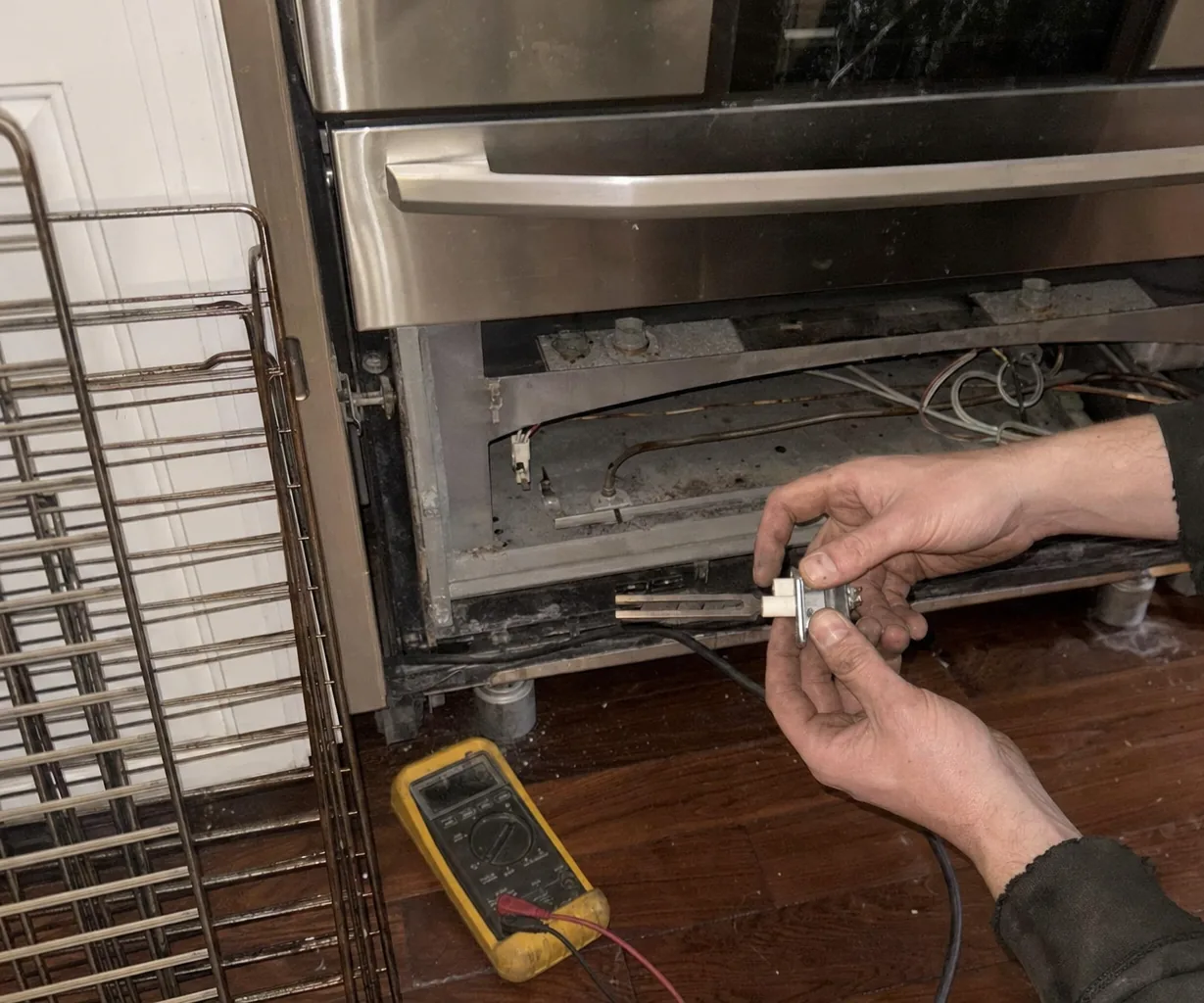
Northeast Florida sees thunderstorms on the order of sixty-eight days a year, which is most afternoons of a summer, and St. Johns County has taken multi-day outages inside recent memory — Matthew in 2016, Irma in 2017, Helene in 2024. Everybody here has a plan for the freezer. Almost nobody connects a storm to the oven that started behaving strangely two months afterwards.
Why the failure is late
A modern built-in cooking appliance is not one machine, it is several small ones talking to each other: a control board, a relay or power board, an ignition or spark module, a display assembly, temperature sensing, and the harness that joins them. All of that runs on low-voltage supplies derived from the mains inside the appliance.
A supply event — a surge on restoration, a spell of low voltage while the network comes back, or a rapid sequence of on-off-on — puts stress on exactly those supply components. Sometimes it kills a board outright and the appliance is dead when the lights come on, which at least has the virtue of being obvious.
More often it does not. Something is left weakened rather than destroyed, and a weakened supply is fine until it is loaded: the appliance works for a month, then begins doing things that read as unrelated faults. A display that resets itself. A clock that loses time. An oven that ignites reliably from cold and not at all when it is already hot. A burner that lights four times out of five. A cooktop that reports a fault, clears it when the breaker is cycled, and reports it again a week later.
Intermittent is the word to listen for. A mechanical fault is usually consistent — a failed igniter fails every time. A stressed electronic supply is inconsistent by nature, and it gets worse as the appliance heats up, because heat is the thing that finds a marginal component.
What the outage itself does that is not electrical
Two other things happen during a multi-day outage that have nothing to do with voltage.
The house stops being air-conditioned. Interior humidity climbs for as long as the power is off, and it climbs everywhere, including inside the cabinet run and inside appliances that are usually dry. That matters most to anything with a ceramic insulator or an exposed connector — igniters and their leads especially.
And the appliance gets used differently afterwards. A kitchen that has been without power for three days gets a heavy cooking day when the power returns, and a heavy day is a load test. Faults that had been sitting under the threshold surface on the first big meal, which is why the timing looks like coincidence when it is not.
Generators are worth a line of their own. A portable generator’s output is not utility power, and electronics that tolerate it in an emergency are not necessarily unaffected by it. If an appliance was run on one, say so.
What to do, and what not to
Do note the date. Even a rough one — “the week of the storm”, “the outage in September” — is enough to change where a diagnosis starts.
Do not sit and cycle the breaker to clear a fault that keeps returning. It works, which is the problem: it converts a diagnosable pattern into a habit, and by the time anyone calls, nobody can say when the fault appears or what it follows. Write down what the appliance was doing when it faulted and roughly how long it had been on. Two lines on the back of an envelope are worth more to us than an hour of guessing.
Do check the obvious first. A tripped breaker, a tripped GFCI on a shared circuit, or a wall switch that somebody flipped during the outage account for a fair share of calls that begin “it died in the storm”.
How we work it
Knowing an outage happened moves the electrical checks to the front of the queue instead of the back. We start at the supply — voltage at the appliance under load, not at rest, and whether the circuit is shared with something that cycles — then the harness and its connectors, then the board’s behaviour when the appliance is hot rather than cold, because that is the condition the fault lives in.
Only then do we look at the component the symptom pointed at. An igniter, a valve or a sensor accused by an intermittent supply will measure perfectly on the bench, and replacing it produces a repair that lasts until the next hot day.
If the answer is a board, we say so, quote it in writing with its lead time, and say plainly where the economics land. On a mechanically sound built-in appliance, a board is very often still the cheaper road — replacing a built-in is rarely just a delivery, because the cut-out, the clearances and the connection were all sized for the unit already in the room.