Service
Wolf cooktop repair — sparking burners and induction zones that cut out
Sealed gas burners that spark without lighting, induction zones that cut out under a pan, electric elements that never reach temperature. The cooktop is the appliance a coastal kitchen is hardest on.
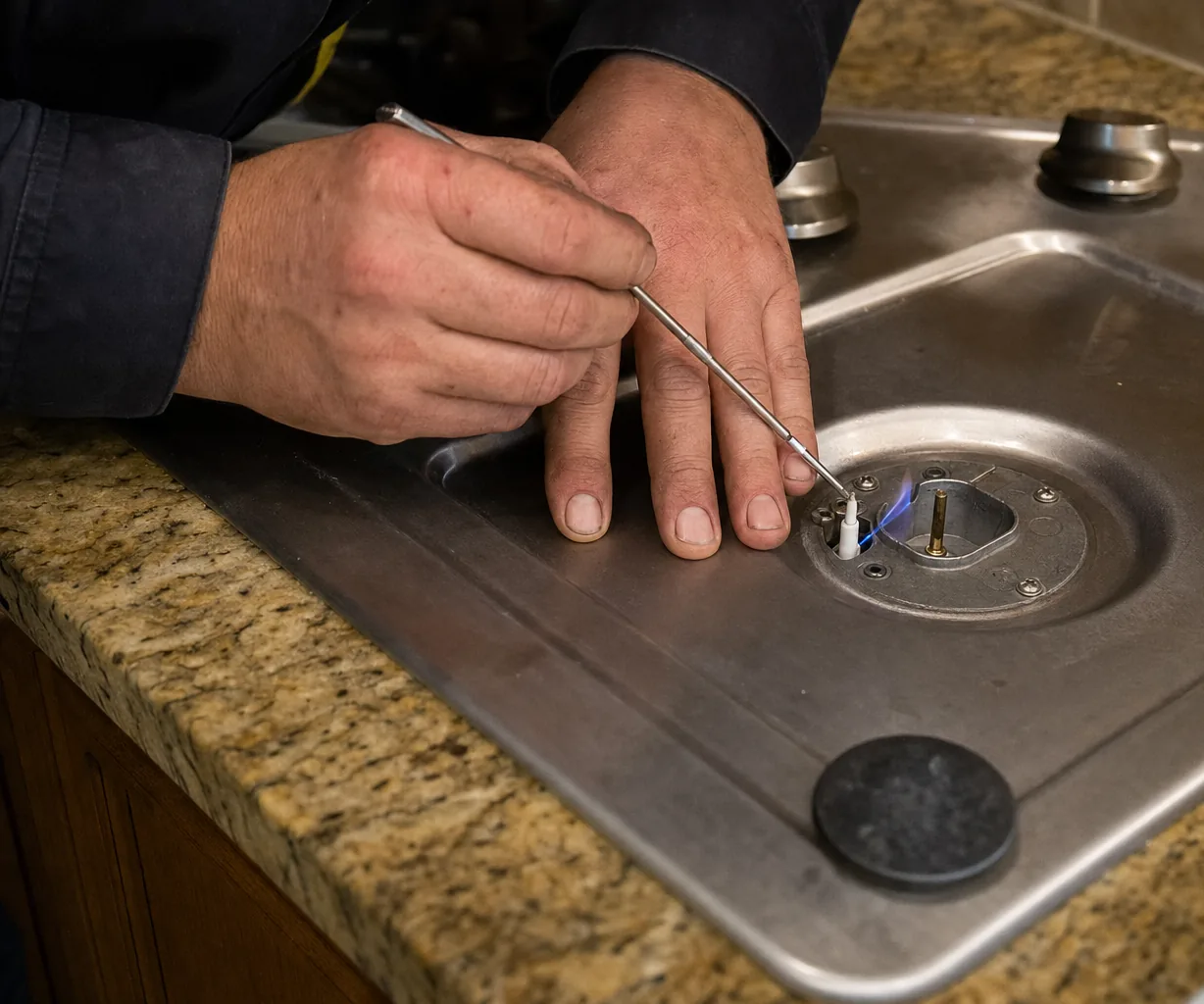
What people describe when they call
- A burner sparks continuously even with every knob turned off
- The flame is small and will not turn down without going out
- An induction zone stops after a few minutes and restarts on its own
- The induction surface reports a pan it can see as no pan at all
- The cooktop beeps and shuts every zone down at once
- An electric element glows on one half of its ring
- The glass surface has a hairline crack near a zone
- The knobs have gone stiff and gritty to turn
- The grates have gone rough and are marking the pans
A cooktop sits flush in a worktop with almost nothing beneath it, which makes it both the simplest appliance in the kitchen and the one most exposed to everything that happens on top of it. Boilovers, salt, cleaning spray and pan weight all arrive at the same few components.
Gas: the flame is the diagnostic
On a sealed gas cooktop the flame itself is the best instrument in the room. Read it before touching anything.
A flame that is small and yellow-tipped and lifts away from the cap is running an air-to-gas ratio it should not have. A flame that is blue and steady at high but dies when you turn it down has a low-flame adjustment that has drifted or a valve that has gummed. A burner that will not light at all while its neighbours do is almost always mechanical: cap seated wrong, port blocked, electrode wet.
The one symptom that is genuinely electrical is continuous sparking with the knobs off. That is a switch stuck closed or moisture bridging a switch, and it will keep clicking until somebody pulls the plug or trips the circuit. It is not dangerous to the house, but it will wear the electrodes out.
Induction: heat is the enemy, and it is underneath
An induction cooktop is a power-electronics module that happens to have a glass lid. The coils are efficient, but the inverter beneath them is not perfectly so, and the waste heat has to leave through a fan and a vent. Anything that blocks that path produces the classic complaint: a zone that works for a few minutes at high power, shuts off, cools, and comes back.
Three things cause that in this county more than anywhere else. Cabinet ventilation that was never cut correctly during a remodel. A drawer beneath the cooktop packed to the top with linens. And, on the island, a fan pulling salt-laden air through a heat sink for a decade until the fins are furred and the bearings are dry.
A zone that does not recognise a pan is a different fault entirely, and it is usually the pan. Induction needs a ferrous base and reasonable contact; a sandwich-base pan that has bowed will drop out at low power and read as absent. Test with a different pan before booking anything.
Electric radiant
Less common in these kitchens but not rare. A ring that glows over half its circumference is a broken element, and there is no repair for it short of replacement. A surface that heats but never gets to full is more often the infinite switch or the control behind it than the element.
Glass, grates and salt
A hairline crack in a glass surface is not cosmetic. The surface is structural, it carries the pan load, and a crack near a zone will propagate under thermal cycling. It is a replacement, and we will say so plainly rather than sell you a diagnosis you do not need.
Cast grates are a different problem, and a specifically coastal one. In 32084 and 32080, where salt air reaches the kitchen every time a window opens, grate coating fails at the contact points first — the four small feet and the ridge under the pan. Once the coating is broken the iron goes, the surface roughens, and it starts marking pan bases. Washing grates and drying them properly matters more here than it does inland, and a grate that has begun to rust is worth replacing before it takes the finish off a set of pans.
Flat $80 to diagnose, credited toward the repair. Written estimate first, 90 days on labour, 365 on parts, genuine OEM parts only.
What gets checked
- Manifold pressure and the regulator setting against the fuel actually supplied
- Every electrode lead for continuity and for a wet or cracked ceramic
- Burner cap seating and port clearance, port by port
- Induction coil resistance and the temperature of its heat sink under load
- Cooling fan operation beneath the surface, which is what an induction top depends on
- Element continuity and the switch or control feeding it
- Valve action through its full travel, including the low-flame stop
Flat $80 diagnostic, credited to the repair. You get a written estimate before any part is ordered or any labour is billed. 90 days on labour, 365 days on parts, genuine OEM parts only.
The fee, then the band the part sits in
Money
What does cooktop and induction repair cost?
The bands below are the ones this work falls into. Everything else on the book is on the pricing page.
| Work | Parts and labour |
|---|---|
| Diagnostic visit | $80 flat, credited |
| Burner valve or orifice service | $210–$650 |
| Igniter or spark module replacement | $190–$500 |
| Oven thermostat or temperature sensor | $170–$520 |
| Control board or touch panel | $420–$1,100 |
Bands, not quotes: they are what this work has actually cost, parts and labour together, from $80 at the door to the firm figure that goes on paper after the diagnosis. The whole table
- What does cooktop and induction repair cost?
- The visit is a flat $80, credited in full against the repair. After that the price follows the component that failed: Burner valve or orifice service runs $210–$650, igniter or spark module replacement $190–$500, parts and labour together. You get a written estimate before any part is ordered or any labour is billed.
- Is the $80 charged on top of the repair bill?
- No. Flat $80 diagnostic covering the visit and the full diagnostic sequence, credited toward the repair once you approve the work. If you decide against the work, the fee stands and the written diagnosis is yours to take anywhere — it names the failed part and the part number.
- When is replacing the appliance the better buy?
- Replacing instead of repairing runs $5,200–$10,500 (wall oven or built-in oven, the usual repair-or-replace comparison) or $8,500–$16,500 (dual-fuel or gas range, 36 inch and up). A comparable Wolf range, rangetop or wall oven, appliance only — before delivery, installation, ventilation or cabinetry. National appliance pricing, not Florida labour. Against those figures a repair at $210–$650 is the cheaper course in most kitchens.
Places this comes up
Written up in full
- What to check before you call us Some of these end the problem without a visit. The rest turn a vague complaint into a specific one, which is the difference between a diagnosis and a guess. Plus the three things not to touch.
- The burner that clicks in an old St. Augustine kitchen The most common call we take, and the one most often fixed without a part. Where the fault actually sits, what you can safely check yourself, and the single symptom that means stop and phone.
- The appliance fault that arrives weeks after the storm Northeast Florida takes thunderstorms most of the summer and has had multi-day outages more than once. Appliance electronics often survive the event and fail some weeks later, which is why the outage never gets mentioned on the call.
What people said after this work
Customer feedback
After Cooktop and induction calls
4.3 out of 5, across 87 customer reviews. Each entry below is one visit, in the words of the person who paid for it.
One induction zone kept dropping out mid-simmer and coming back a minute later. He found the fan beneath the glass choked with dust and a lead hanging loose off its tab, cleared one and remade the other.
Marisol P.
One cast grate had warped and pans rocked on it whenever the burner ran. He fitted a new grate, checked the others against a straight edge and levelled the caps while he had the top apart.
Odalys G.
The burner works and the diagnosis was right. What I did not like was being told the part was on the shelf, then waiting nine days for it with no word unless I rang the office and asked.
Rowena D.