symptom
The burner that clicks in an old St. Augustine kitchen
The most common call we take, and the one most often fixed without a part. Where the fault actually sits, what you can safely check yourself, and the single symptom that means stop and phone.
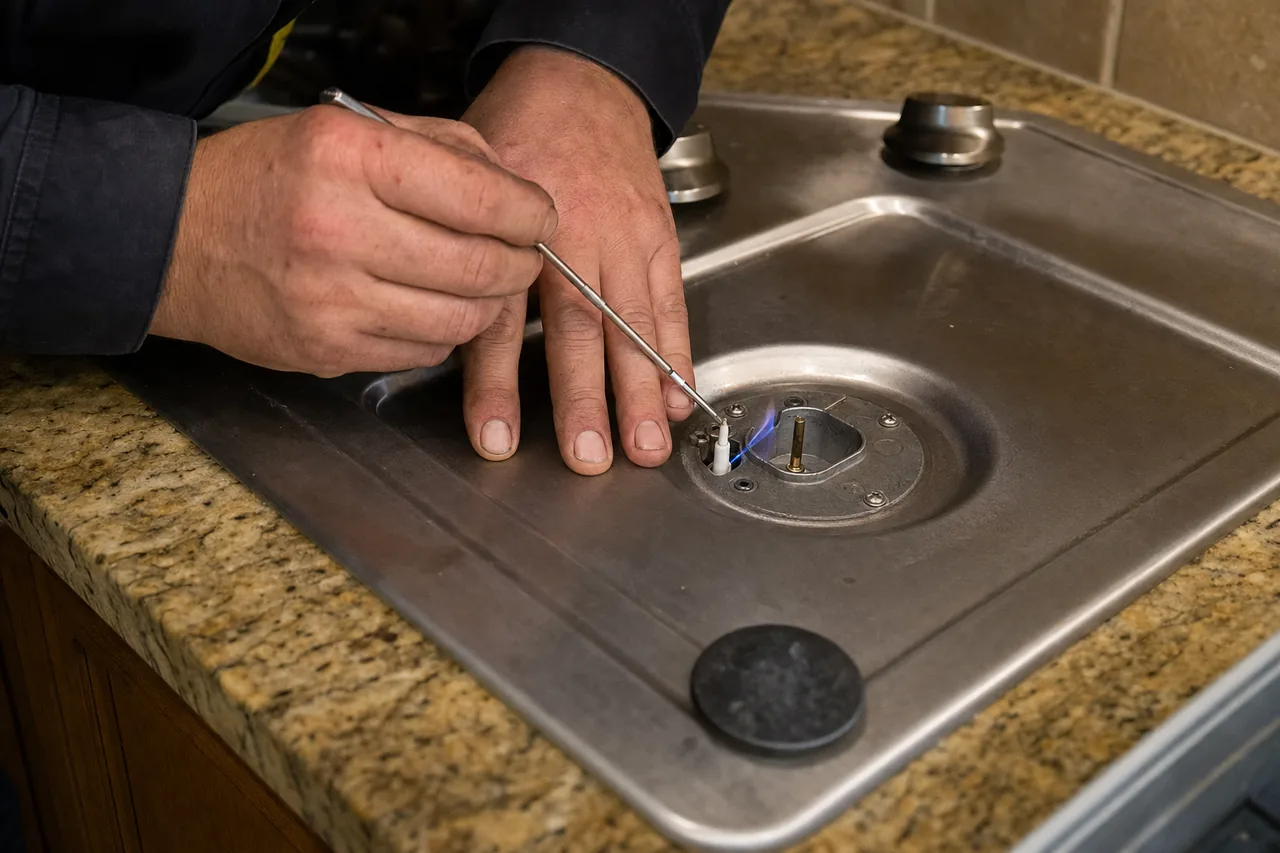
It is the most common call we take. One burner sparks and sparks and never catches, while every other burner on the cooktop lights first time. It sounds electrical, it is usually not, and about half of these are resolved in ten minutes by the owner once they know where to look.
What is actually happening
A sealed gas burner needs three things simultaneously: gas arriving at the ports, air mixing with it in the right proportion, and a spark in the right place at the right moment. The clicking tells you the third is happening. So the fault is almost always in the first two, or in the geometry that puts the spark where the gas is.
That geometry is tighter than people expect. The electrode has to fire across a specific gap, into a specific point in the emerging gas stream. Move the burner cap a millimetre and the spark is firing into air.
Four things to check, in order
One: the cap. Lift the burner cap off and set it back down deliberately. Caps have a seat, and they only sit correctly one way. A cap lifted for cleaning and dropped back at a slight angle is the single most common cause of this complaint, and the fix costs nothing. While it is off, look at the ring of ports underneath. If any are blocked with carbonised boilover, a wooden toothpick or a straightened paperclip will clear them. Not a drill, not a needle file — the port size is a calibration and enlarging it is permanent.
Two: moisture. If the cooktop has recently been cleaned, or something has boiled over, the ceramic around the electrode may simply be wet. A wet ceramic conducts the spark away before it can jump the gap, so you get clicking with no ignition. Dry it properly and leave it an hour. This is why the fault so often appears the morning after a big cleanup and disappears by itself the next day.
Three: the neighbours. Try every other burner. What you learn from this is worth more than anything else you can do. If every burner lights and only one does not, the fault is local to that burner: cap, ports, electrode. If nothing on the whole cooktop sparks, the fault is the module or its supply, and that is a service call.
Four: the flame you do get elsewhere. Look at a burner that works. If its flame is blue, steady and sits down on the cap, the gas supply is fine and the problem really is local. If the working flames are yellow-tipped and lifting away from the cap, the whole appliance is running the wrong air-to-gas ratio, and the burner that will not light is the first casualty rather than the only problem. That points at supply pressure, at a regulator, or at a fuel conversion — natural gas to LP or back — that was not completed on every valve. On Anastasia Island, where houses on tanks and houses on a main sit a few streets apart, half-finished conversions are common enough that we ask about them by default.
The one symptom that means stop
Continuous sparking with every knob off.
That is not a burner fault. It is a switch stuck closed, or moisture bridging a switch, and the module will keep firing until something interrupts it. It will not set the house on fire, but it will erode the electrodes and it will not stop on its own. Turn the appliance off at the breaker or unplug it, and call.
The same applies, obviously, to any smell of gas that persists with everything off. That is not a diagnostic exercise. Shut the supply off at the appliance valve, ventilate, and get someone out.
What we do if it comes to a visit
We measure rather than swap. Manifold pressure at the appliance, against the figure for the fuel actually being delivered. Module output. Continuity on every electrode lead, because a lead that has chafed against a chassis edge shorts intermittently and produces a fault that comes and goes with the weather. Cap seating and port clearance, burner by burner. Valve action through the full travel, including the low-flame stop.
That sequence takes about twenty minutes and it ends with a number rather than an opinion. The flat $80 diagnostic covers it, and it comes off the bill if you go ahead with the repair.