symptom
The oven is not heating, and what that narrows to
Not heating at all and not heating enough are two different faults. What gets measured first on a Wolf oven: the burner igniter's current draw, the safety valve it is meant to open, the temperature sensor's resistance, the door seal. The control board comes last, not first.
Two people ring and say the same five words, and they are describing different appliances. One has an oven that lights, runs, and turns out a tray of biscuits pale on the bottom. The other has an oven whose display counts up to temperature while the cavity stays at room temperature all afternoon. Both said “it is not heating”. Only the second one is.
So the first thing that happens on the phone is that the sentence gets taken apart. Does the cavity get warm at all? Does the preheat tone ever sound? Does the broil element or the broil burner behave differently from the bake one? Three answers, and the visit already has a shape before the van leaves.
A glow is not a measurement
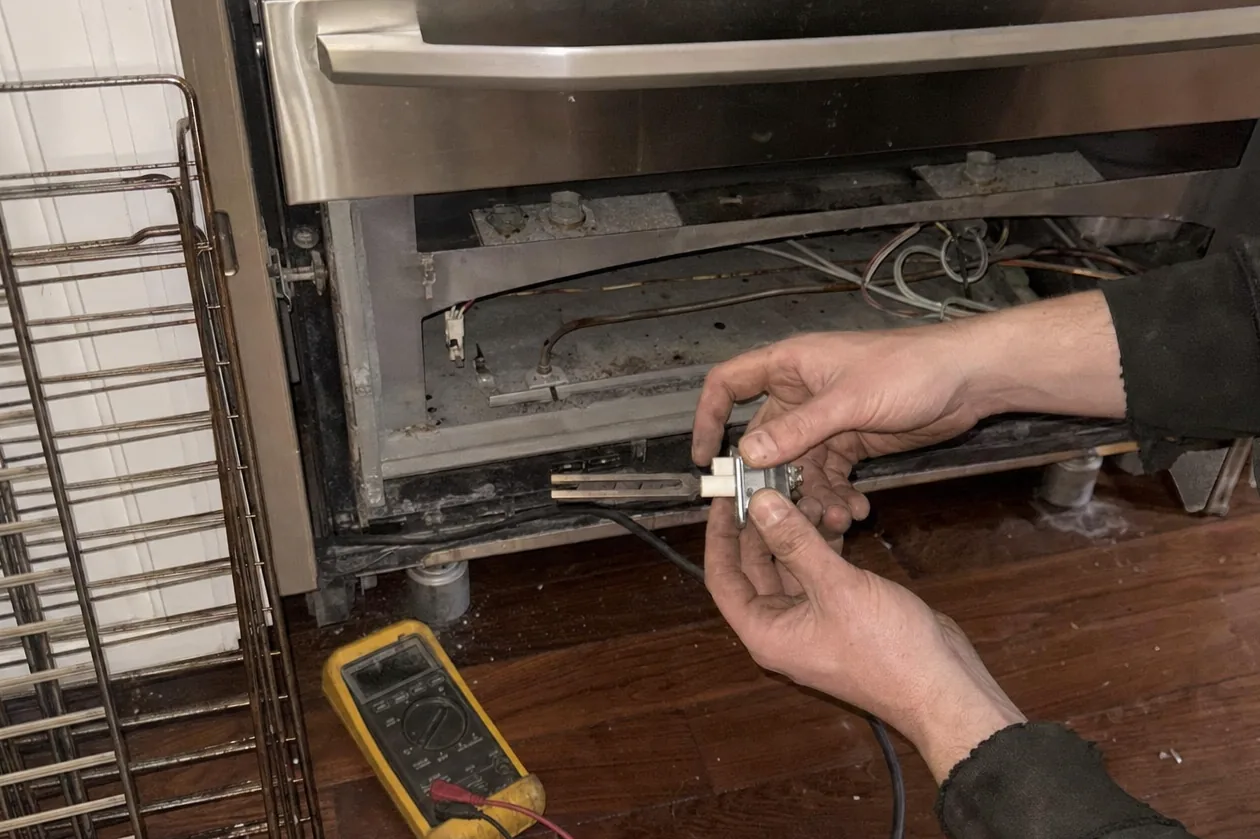
On the gas side, the part that fails most often is the one customers most often rule out by looking at it. A hot-surface igniter in a bake burner does two jobs: it gets hot enough to light the gas, and it draws enough current through its own circuit to pull the safety valve open. Those two jobs weaken at different rates.
An igniter well past its useful life still glows a convincing orange. It simply no longer pulls what the valve needs, so the valve never opens, so no gas arrives, so the glow sits there in an empty burner tube until the control gives up. Every part of that is visible through the vent slot and none of it is diagnostic. The measurement is a clamp on the igniter leg with the oven calling for heat, watched for the whole warm-up rather than glanced at.
That is also why “it lit yesterday and not today” is a symptom rather than a contradiction. A marginal igniter opens the valve on a warm day and fails to on a cold morning, and it will do that for weeks before it stops altogether.
The other half of the gas question
If the igniter draws what it should and the burner still does not light, the question moves to the gas itself. Parts of St. Johns County sit outside the natural-gas mains and run on a tank, and a range or rangetop that was converted for it carries different orifices and a different regulator setting. A conversion done to the letter is invisible for years. One done approximately shows up as a lazy flame, a long light-off, and an oven that reaches temperature eventually but never quickly.
Say which fuel the house is on when you call. It is one of the few facts that changes what goes in the van.
What the sensor is actually saying
An electric bake element that has failed open is the simple case, and it is the one most likely to have been diagnosed correctly before we arrive. The harder case is the oven that heats, holds a temperature, and holds the wrong one.
That is the temperature sensor’s account of itself. It is a resistance probe: it reads one value at one temperature, and when it drifts, the control board believes it. The board is not faulty. It is doing exactly what it was told by a part that has started lying quietly. A cavity thermometer read against the display after a full settle — not two minutes after the tone — is what separates a drifted sensor from everything else, and it takes longer than any other check on the visit.
Where the door comes into it
An oven that will not reach temperature and an oven that cannot hold one are often the same fault seen from two ends, and the fault is sometimes not inside the appliance at all. A gasket that has flattened at one corner, an inner glass pack that has slipped, a hinge that has lost tension and lets the door sit a degree proud: each of those bleeds heat continuously, and the appliance responds by running its heat source harder and longer. Nothing has failed. Something has stopped sealing.
The check is free and you can do it before you call. Bring the oven to temperature, then move the back of your hand slowly along the door edge, down one side and across the top. Warm is normal. A stream of hot air on one corner is an answer.
Why the board comes last
In the old city, where cabinet openings were cut to accept an appliance rather than built for one, the cooling path behind a built-in oven is often shorter than the specification asked for, and control boards in those runs live a hotter life than boards in a purpose-built opening at Palencia. That is a real difference, and it is still not a reason to lead with the board.
A board is the most expensive assembly in the appliance and the least likely cause of a heating complaint. Boards fail in ways that look like a board: a dead display, a function that no longer appears, a relay that will not drop out. An oven that heats badly, unevenly or slowly is describing the heat, the fuel or the seal, and every one of those is cheaper to test than a board is to guess at.
The order is not a preference. It is what stops a household paying for the dearest part in the cabinet to fix a fault in the cheapest one.
What to have ready
The model and serial number from the rating plate, the fuel the house is on, and one sentence about what the appliance did in the days before it stopped. That last one does more work than it sounds like: an oven that got slower over a month and an oven that quit between two dinners are almost never the same fault, and the difference is not visible once we are standing in front of it.